Binaural beats are a listening phenomenon that occurs when slightly different tones are delivered separately to your left and right ears. Rather than hearing only two steady tones, you may perceive a rhythmic beat related to the difference between their frequencies.
That simple idea sits behind a large collection of recordings marketed for focus, relaxation, meditation and other purposes. Understanding how the effect works is a useful first step toward evaluating those recordings.
This guide explains the sound itself, the terminology you will encounter and the distinction between hearing a beat and establishing a benefit.
Exploring a commercial brainwave audio program?
View The Brain Song presentation and current offer
Check the seller’s description and purchase terms before deciding.
A Simple Binaural Beat Example
Imagine a stereo recording with these two channels:
| Channel | Tone delivered |
|---|---|
| Left ear | 200 Hz |
| Right ear | 210 Hz |
| Difference | 10 Hz |
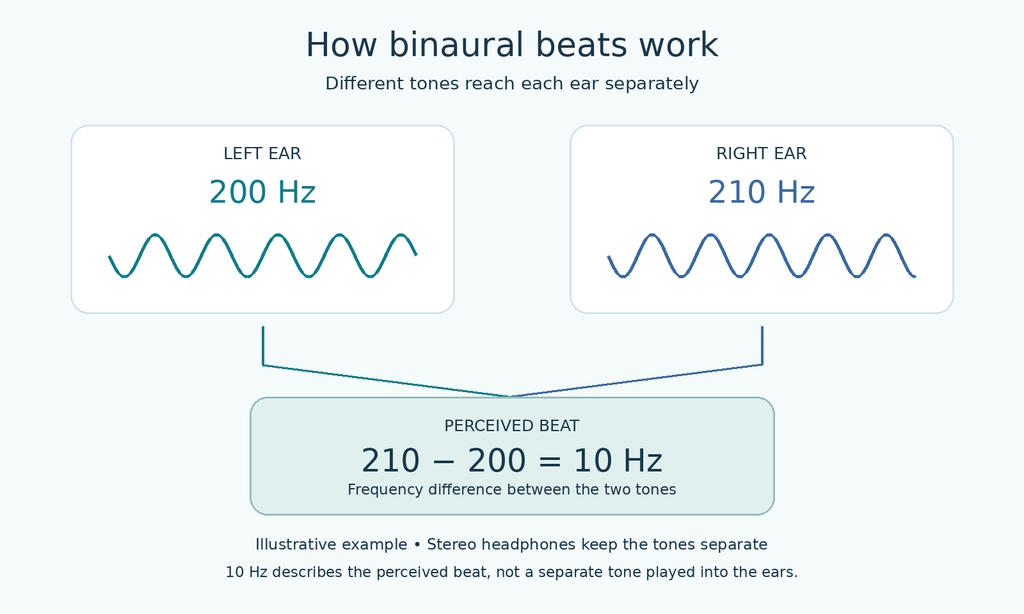
The difference between the tones is 10 Hz. This is the binaural beat frequency in this example.
The audible tones and the perceived beat are different parts of the description. You are listening to the higher-frequency carrier tones while perceiving a slower rhythmic effect.
Researchers distinguish this arrangement from combining both tones into one signal before playback. Delivering neighbouring tones separately to each ear is central to the binaural arrangement.
The numbers here illustrate the mechanism. They are not a recommended setting for concentration, relaxation or any other outcome.
Why Is It Called “Binaural”?
“Binaural” refers to both ears.
In a binaural beat recording, each ear receives a different tone. The listening effect depends on the relationship between those inputs.
That is why a stereo recording matters. A file can contain two channels, but the playback system must preserve their separation for the intended presentation.
A recording played through a single phone speaker does not deliver one isolated tone to each ear in the same way.
Our guide to headphones and binaural beat playback explains the practical differences between headphones, speakers and mono playback.
What Do Binaural Beats Sound Like?
The experience depends on the recording.
A simple demonstration may contain little more than steady tones and a subtle wavering sensation. A commercial track might place the tones beneath music, rainfall, ocean sounds or another background.
The rhythmic component may be more noticeable in some recordings than others. A prominent pulsing sound also does not prove that a track uses binaural beats; other audio techniques can create pulses.
When choosing a recording, look for a description of what it contains rather than relying on its title.
Useful details include:
- Whether the recording uses binaural beats, another rhythmic technique or ordinary music.
- Whether stereo headphones are required.
- Whether music or background noise is included.
- Whether spoken guidance or sudden changes occur.
- Whether a sample is available before purchase.
A clear description helps you understand what you are selecting, even before considering any advertised benefits.
Carrier Frequency vs Beat Frequency
Two different uses of “frequency” can make descriptions confusing.
Carrier Frequency
The carrier tones are the sounds delivered to the ears. In the earlier example, these were 200 Hz and 210 Hz.
Their frequencies describe the pitches used to create the listening arrangement.
Beat Frequency
The beat frequency describes the difference between those tones: 10 Hz in the example.
It does not mean that the entire soundtrack consists of a single audible 10 Hz tone.
This distinction matters when you see a recording labelled “10 Hz audio.” The label alone may not tell you whether it describes a binaural difference, an audible pulse rate or something else.
Before drawing conclusions from a frequency label, check how the recording was constructed.
What About Delta, Theta, Alpha, Beta and Gamma?
These names refer to frequency bands used when discussing brain activity. They also appear in descriptions of binaural beat recordings.
You might encounter titles such as “alpha focus,” “theta meditation” or “gamma audio.” These labels can identify the frequency range the producer intends to use, but they do not establish the promised result.
Our brainwave frequency chart explains the terminology and separates frequency descriptions from benefit claims.
For a beginner, the most useful habit is to treat a frequency label as a detail to investigate. Ask what it refers to and what evidence connects that particular recording to the advertised outcome.
Are Binaural Beats the Same as Brainwave Entrainment?
The terms are related, but they describe different things.
A binaural beat is an auditory phenomenon. Brainwave entrainment is the broader idea that rhythmic stimulation can influence the timing of brain activity.
The existence of the listening effect does not automatically establish the stronger claim that a recording reliably changes brain activity in a desired way.
For the wider explanation, see our guide to brainwave entrainment and its limits.
Keeping these concepts separate helps you read product descriptions more carefully. A seller may explain how two tones create a beat, then move directly to a promise about memory or concentration. The explanation of the sound is only one part of the argument.
Does Hearing a Beat Prove That It Works?
It depends on what “works” means.
If the question is whether binaural beats are a recognised auditory phenomenon, that is different from asking whether a particular recording improves learning, sleep or everyday functioning.
Evidence for one claim cannot simply stand in for evidence for another.
A 2023 systematic review examined 14 studies of binaural stimulation and brain oscillatory activity. It found inconsistent results: five studies supported the entrainment hypothesis, eight did not, and one reported mixed findings. The studies also differed substantially in their methods.
That review concerns entrainment evidence; it should not be treated as a final answer to every possible application of audio.
For practical reading, separate three questions:
- What sound is being presented?
- What response was measured?
- Does that response support the benefit being advertised?
A convincing explanation should connect those steps rather than assume they are interchangeable.
Binaural Beats vs Other Rhythmic Sounds
Not every rhythmic recording is binaural.
Monaural Beats
Monaural beats involve combining neighbouring tones into a signal before it reaches the ears. The resulting beat is present in the combined sound, rather than depending on separate tones being delivered to each ear.
Researchers distinguish this physical beat arrangement from binaural presentation.
Isochronic Tones
Isochronic tones use regularly repeating sound pulses. A listener may hear a more obvious on-and-off rhythm.
The format differs from presenting two steady tones separately to the ears. For a fuller explanation of the listening and equipment differences, read our comparison of binaural beats and isochronic tones.
Ordinary Background Music
A soundtrack can also consist of music without a binaural component.
Words such as “focus,” “calm” and “meditation” describe an intended use or atmosphere. They do not identify the technical construction of a recording.
A pleasant playlist does not need to contain binaural beats to be enjoyable. Likewise, adding binaural beats does not automatically make music more useful.
How to Read a Binaural Beat Description
Before trying or purchasing a recording, look for answers to a few straightforward questions.
What Is Included?
Is it a single track, a collection, an app or access to streamed recordings? Does it include spoken instructions or only audio?
What Equipment Does It Require?
Check whether the creator specifies stereo headphones and whether the recording can be downloaded or requires an internet connection.
What Does the Frequency Label Describe?
A number without an explanation may leave you guessing about the sound. Look for a distinction between the carrier tones and the beat rate.
What Is Being Promised?
An invitation to try a listening experience is different from a guarantee of improved memory or a claim to treat a medical condition.
What Supports the Claim?
Look for relevant research and a clear explanation of its limitations. A list of scientific terms is not a substitute for evidence about the advertised result.
These questions can help you evaluate both free recordings and paid programs.
A Practical Way to Begin
If you decide to explore binaural beats, begin with a recording that clearly explains its format and playback requirements.
Choose a setting where listening will not interfere with responsibilities or important sounds around you. Use a comfortable volume and stop if the experience is unpleasant.
You do not need to select a complicated schedule or commit to a long session simply to understand the sound.
Our step-by-step guide to using binaural beats covers setup and a simple observation routine.
Keep your observations specific. You might notice whether the sound was comfortable, distracting or suitable for the activity. Those observations can guide your preferences without being treated as proof of a lasting cognitive change.
Common Questions About Binaural Beats
Are Binaural Beats Music?
Not necessarily. A simple recording can use tones alone. Other tracks combine the tones with music or background sound.
“Binaural beats” describes the listening arrangement, not a musical genre.
Does a Stronger Pulse Mean a Better Recording?
No such conclusion follows from how prominent the rhythm sounds.
An obvious pulse might reflect another audio technique, and greater loudness or intensity does not establish greater usefulness.
Can a Frequency Label Tell Me What I Will Feel?
It cannot reliably tell you what your individual experience will be.
Treat labels as descriptions to investigate rather than instructions about how you should feel.
Is Every Recording Labelled “Brainwave Audio” Binaural?
No. The label can cover different formats. Read the creator’s technical description and playback instructions.
Do I Need to Buy a Program to Understand Binaural Beats?
No. A clearly explained demonstration can introduce the basic phenomenon. A purchase decision should be based on what a particular program offers and whether its terms and evidence meet your expectations.
Understand the Effect Before Evaluating the Promise
Binaural beats begin with a straightforward arrangement: slightly different tones presented separately to the ears, producing a perceived beat associated with their frequency difference.
Understanding that mechanism helps you interpret recording descriptions, recognise why stereo playback matters and distinguish binaural audio from other rhythmic sounds.
From there, evaluate each claim separately. Hearing a beat, enjoying a track and demonstrating a meaningful benefit are different questions. Clear expectations make it easier to explore the audio without asking a frequency label to tell you more than it can.
Want to examine The Brain Song further?
Check the current offer, access details and refund conditions